Why beta.10 Was Older Than beta.9
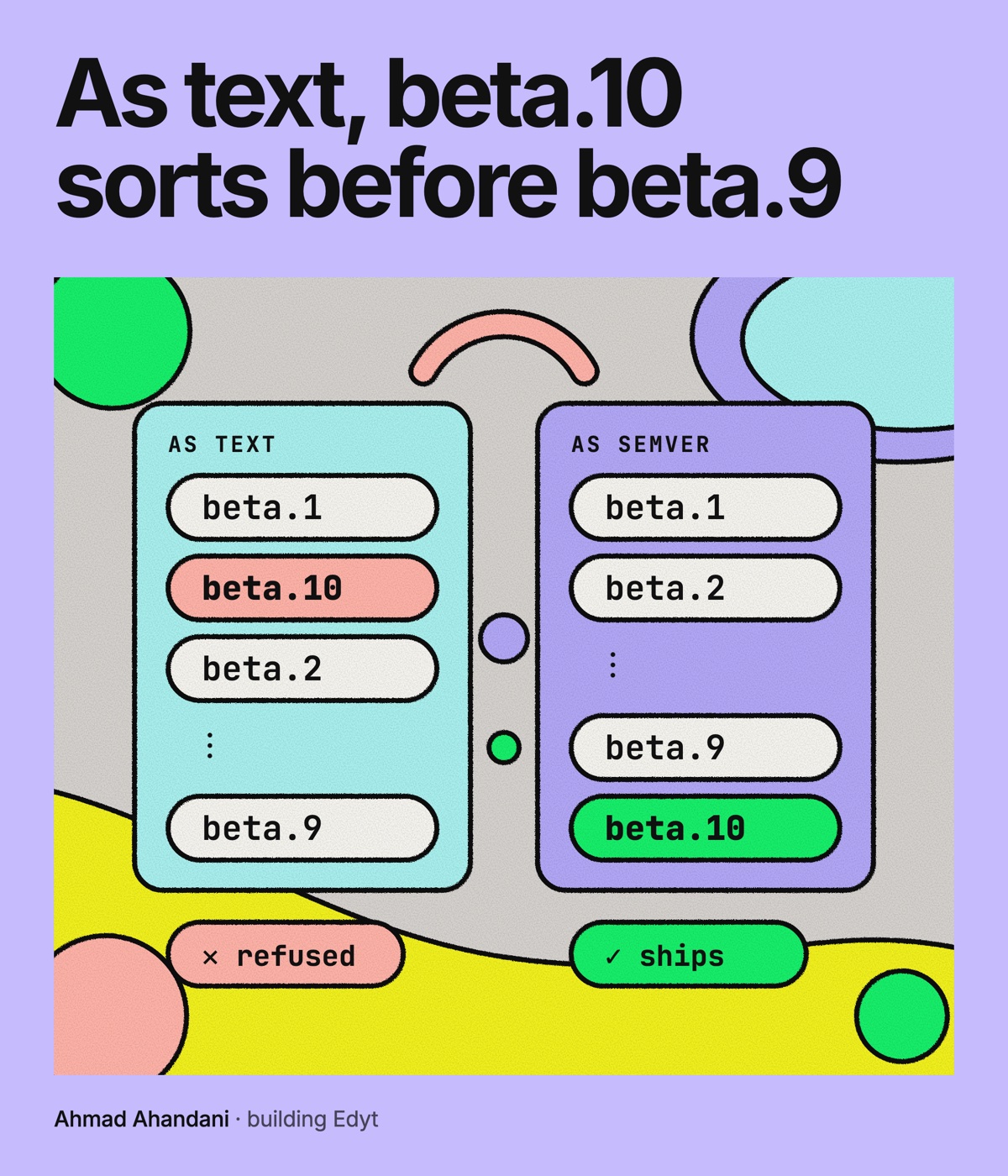
My release script refused to ship Edyt 0.115.0-beta.10. It was sure beta.10 was older than beta.9.
The 0.115.0 release went all the way to beta.17, so this was not a corner case for long. Here is what went wrong, why it stayed hidden for nine betas, and what the fix looks like.
The Guard
Before the script uploads a build, it reads the version that is already live on each platform's update feed and refuses to publish anything older. Moving a feed backwards is a real mistake, not a harmless no-op: it would offer every user on that platform a downgrade.
The check runs as an inline node -e inside the release script. It split each version at the dash, compared major, minor and patch as numbers, and then did this with the prerelease part:
const parse = (v) => {
  const [core, pre] = String(v).split('-')
  return { n: core.split('.').map((x) => Number.parseInt(x, 10) || 0), pre: pre || null }
}
// ...major, minor and patch compared as numbers...
process.exit(b.pre && a.pre && b.pre > a.pre ? 0 : 1)
The core version was handled correctly. The bug was only in that last line, which compares two strings with >.
Why It Hid for Nine Betas
Strings compare character by character. "beta.9" and "beta.10" match up to beta., and then it is "9" against "1". Since "1" comes before "9", the string "beta.10" sorts before "beta.9", and the guard decided the new build was older than the live one.
For beta.1 through beta.9 this never mattered. Single digits sort the same way as text or as numbers, so every comparison gave the right answer. A test that checked beta.1 against beta.2 would have passed. The first comparison that could fail was beta.9 against beta.10, and from then on every beta was refused.
What Semver Actually Says
Section 11 of the semver spec spells out how prerelease versions compare:
- Split the prerelease on dots and compare the parts left to right.
- Parts that are only digits compare as numbers.
- Other parts compare as text.
- A numeric part always sorts below a text part.
- If every part so far is equal, the version with more parts is newer.
The fix is a small function that follows those rules:
const comparePre = (left, right) => {
  const x = left.split('.')
  const y = right.split('.')
  for (let i = 0; i < Math.max(x.length, y.length); i += 1) {
    if (x[i] === undefined) return -1
    if (y[i] === undefined) return 1
    const xNumeric = /^[0-9]+$/.test(x[i])
    const yNumeric = /^[0-9]+$/.test(y[i])
    if (xNumeric && yNumeric) {
      if (Number(x[i]) !== Number(y[i])) return Number(x[i]) > Number(y[i]) ? 1 : -1
      continue
    }
    if (xNumeric !== yNumeric) return xNumeric ? -1 : 1
    if (x[i] !== y[i]) return x[i] > y[i] ? 1 : -1
  }
  return 0
}
process.exit(b.pre && a.pre && comparePre(b.pre, a.pre) > 0 ? 0 : 1)
Now beta.10 beats beta.9, beta.1 beats beta, and rc.1 beats beta.12 because rc sorts after beta as text.
If You Compare Versions Yourself
If your project already has a dependency manager, a semver library handles all of this and you can skip writing it. If you do compare versions by hand, in a release script, a CI step or an updater, add these cases to your tests:
beta.9againstbeta.10betaagainstbeta.1beta.12againstrc.11.0.0-beta.3against1.0.0, where the release wins
The first one is the one that bit me. It is also the one that only shows up after your tenth beta, which is a long time to wait for a bug.